
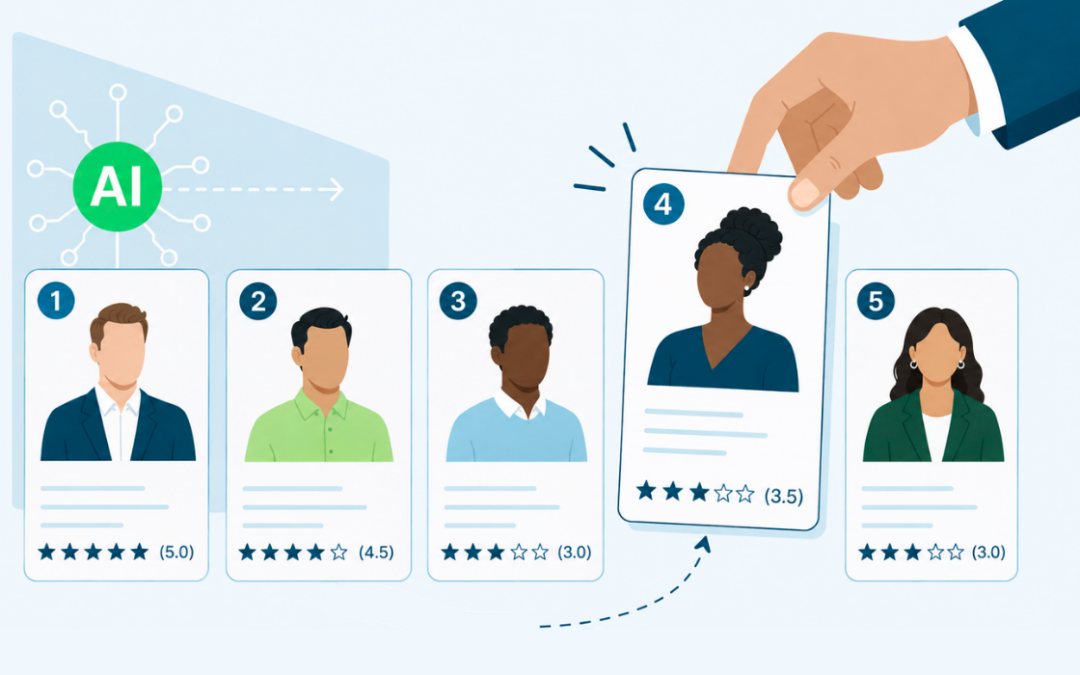
AI is rapidly removing friction from hiring. It can research candidates, summarize resumes, draft outreach, structure interview notes and help businesses process applicant pools at a scale that would have been impossible only a few years ago.
That efficiency is valuable. But new Stanford research highlights an important distinction: using AI to support hiring decisions is very different from allowing AI to make them.
What is the appropriate boundary between AI automation and human judgment in executive recruiting?
AI should handle the work that benefits from speed, scale and consistency: organizing information, identifying patterns, documenting interviews and reducing administrative burden.
Human judgment should handle the work that depends on context, trust and accountability: defining what success means, evaluating leadership potential, testing assumptions, interpreting ambiguity and deciding whether an executive can lead a specific business through a specific moment.
What are the risks of relying too heavily on AI in hiring?
Recent Stanford research reinforces why that boundary matters. Researchers analyzed 4 million real job applications from 3.4 million people across 150 employers and 11 industries, finding that AI screening tools can produce demographic disparities and contribute to what they call “algorithmic monoculture.”
Approximately 90% of U.S. employers now use AI screening tools to sort or rank applicants. In the study, 26% of Black applicants and 15% of Asian applicants applied to positions where the AI system produced adverse impact against their racial group under the EEOC’s four-fifths test. (Stanford HAI)
The researchers estimated that approximately 40,000 additional applications from Black and Asian candidates would have progressed if those groups had been recommended at the same rate as the system’s most favored group. (Stanford HAI)
Stanford also found evidence that employers using the same screening system may make similar decisions about the same candidates. Approximately 10% of candidates who applied to four positions screened by the same system were rejected from all four, more frequently than researchers would expect if employers were making statistically independent decisions. This “algorithmic monoculture” can cause qualified candidates to be repeatedly overlooked when multiple employers rely on the same automated screening system. (Stanford HAI)
How does the use of AI affect candidate participation?
Candidate participation may also decline when applicants know AI is involved. In a separate Stanford field experiment involving 4,562 jobseekers, participation was approximately 25% lower when candidates were explicitly told AI was being used in job matching, compared with human matching or when the source of the match was not specified. (Stanford Digital Economy Lab)
These findings do not mean that companies should avoid AI in recruiting. They reinforce the case for treating AI outputs as inputs to a broader decision-making process rather than as final judgments.
Why does human judgment still matter in executive recruiting?
AI can quickly compare CFO candidates’ experience with a company’s stated requirements and organize interview notes into a consistent scorecard. Human judgment must determine whether a candidate can challenge a founder constructively, build trust with the leadership team and lead through a period of transformation.
Similarly, AI can identify executives who have managed comparable revenue, teams or operational complexity. Experienced search professionals must decide whether those achievements are transferable to the company’s culture, ownership structure and current business challenges.
The boundary is simple:
Automate the process. Do not automate the judgment.
AI can help identify who appears to fit a profile. Experienced search professionals must determine who can earn trust, navigate complexity and deliver results in the real world.
That distinction matters most in executive hiring, where the cost of a wrong decision extends beyond a missed skill. It can affect culture, strategy, succession, investor confidence and the future of the company.
How can 3P Partners help with executive hiring?
3P Partners combines the efficiency of modern technology with the judgment of experienced executive search professionals.
We help family-owned and private equity-backed companies recruit CFOs, COOs, CROs and other senior leaders across the food, beverage, CPG and agribusiness sectors.
Contact 3P Partners to discuss your next leadership search.